
Why Most DSCR Calculators Don't Actually Tell You If Your Deal Works

Most free DSCR calculators give you one number. A deal-grade calculator gives you eight. Here's what to look for - and why it matters before you make an offer.

DSCR LOANS

Nick Thomas

5/31/20265 min read

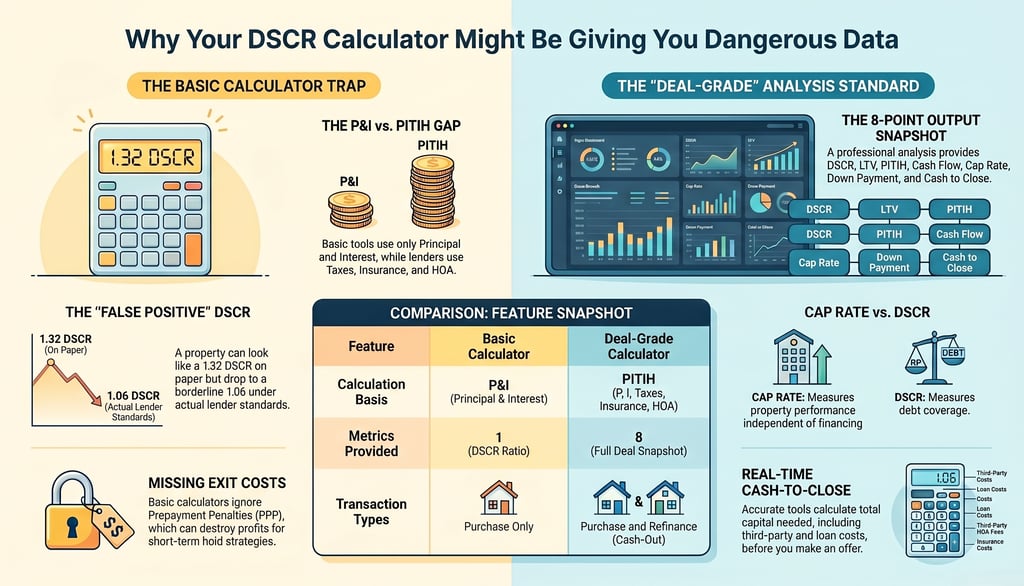
Infographic comparing basic DSCR calculators to deal-grade analysis for real estate investment loans.

Most free DSCR calculators do one thing: divide your rent by your mortgage payment and spit out a ratio. That's fine for a homework exercise. It's not enough to evaluate whether to make an offer on a $400,000 rental property.

Before you trust a number from any calculator - including ours - you need to know what it's actually computing, what it's leaving out, and whether it outputs enough information to make a real decision.

This article breaks down what separates a basic DSCR calculator from a deal-grade analysis tool, with a direct comparison to what the Cape Henry Capital DSCR Loan Calculator actually outputs.

What Most Free DSCR Calculators Give You

The majority of DSCR calculators available online - from lenders, banks, and real estate sites - are built around a simple three or four-input model:

  • Monthly rent

  • Interest rate

  • Purchase price or loan amount

  • Down payment (sometimes)

They return one number: your DSCR score. A few also show an estimated monthly payment.

That's it.

Here's the problem: knowing your DSCR ratio alone doesn't tell you how much cash you need at closing, whether the deal actually cash flows after all costs, what your equity position looks like, or how the property performs as an investment independent of its financing. And none of them ask about your prepayment penalty - which can significantly affect whether a deal makes sense for your hold strategy.

You're getting one data point on a decision that involves eight.

What a Deal-Grade DSCR Calculator Actually Outputs

A calculator built for real estate investors - not just for mortgage pre-screening - should output a full deal snapshot. Here's what that looks like, and what each metric actually tells you.

Most calculators give you the first row. The Cape Henry Capital DSCR Calculator gives you all eight - in real time, as you type. And it does this across both Purchase and Refinance scenarios in the same tool, with the refinance mode swapping in Loan Payoff and outputting Cash-Out Amount instead of Cash to Close.

Run a full deal analysis now →

Head-to-Head: Cape Henry Capital vs. Typical Competitor Calculators

We looked at how the most commonly referenced free DSCR calculators perform against a real investor use case. Here's what we found.

Other DSCR Lenders' Calculators

Most DSCR calculators offered by other lenders fall into one of two categories: basic slider tools that return a single DSCR score without accounting for taxes, insurance, or HOA - meaning the number they show is almost always higher than what your lender will actually calculate - or more feature-rich tools that add scenario saving and property comparison but still stop short of a full deal picture, leaving out cash to close, monthly cash flow, and any consideration of prepayment penalties.

Cape Henry Capital DSCR Calculator

Purchase inputs: Estimated value, purchase price, loan amount, monthly rent, annual insurance, annual property taxes, monthly HOA, interest rate, loan term, prepayment penalty (PPP), closing costs (third party), and other loan costs.

Purchase outputs: Monthly P&I, monthly PITIH, DSCR score, LTV, cap rate, monthly cash flow, down payment required, and cash to close.

Refinance inputs: Estimated value, loan payoff, loan amount, monthly rent, annual insurance, annual property taxes, monthly HOA, interest rate, loan term, prepayment penalty (PPP), closing costs, and other loan costs.

Refinance outputs: Monthly P&I, monthly PITIH, DSCR score, LTV, cap rate, monthly cash flow, and cash-out amount.

The key difference: Cape Henry Capital's calculator uses PITIH - not P&I - to calculate your DSCR, matching the actual method lenders use in underwriting. What you see is what your lender will see.

Why the PITIH Distinction Matters More Than You Think

Here's a concrete example. Same property, two different calculators:

P&I-only calculation (what most calculators show):

  • Monthly P&I: $1,818

  • DSCR: $2,400 ÷ $1,818 = 1.32 ✅ Looks strong

PITIH calculation (what lenders actually use):

  • Monthly PITIH: $1,818 + $300 (taxes) + $150 (insurance) = $2,268

  • DSCR: $2,400 ÷ $2,268 = 1.06 ⚠️ Borderline

That's not a rounding difference. That's the gap between a confident offer and a borderline approval. If you're using a P&I-based calculator, you're evaluating deals on a number your lender will never see.

What Is a Prepayment Penalty - and Why Does It Belong in Your Calculator?

A prepayment penalty (PPP) is a fee charged by some lenders if you pay off your loan early - whether through a sale, refinance, or large principal payment - within a specified window, typically the first 1 to 5 years of the loan term.

DSCR loans commonly carry prepayment penalties because they're originated for portfolio investors, not owner-occupants. The lender is pricing in a longer hold assumption. If you exit early, they recoup some of the expected interest income through the penalty.

Why it matters for deal analysis:

Most investors focus on the rate and the DSCR. But if you're buying a property you plan to sell or refinance within 3 years, a prepayment penalty can meaningfully erode your net return - and in some cases flip a profitable exit into a break-even.

Common DSCR prepayment structures include:

The Cape Henry Capital DSCR Calculator includes a PPP field so you can factor the penalty into your cash-out or exit analysis before you commit. If you're modeling a refinance scenario with a loan that has an existing PPP, that cost should be part of what you're calculating - not a surprise at closing.

Quick rule of thumb: If your hold strategy is 5+ years, a step-down PPP usually costs you nothing - you'll outlast it. If you're planning a BRRRR refinance or a value-add flip within 2–3 years, negotiate for a shorter penalty window or factor the cost into your offer price.

What to Look for in Any DSCR Calculator

Whether you use Cape Henry Capital's tool or another, here's a quick checklist before you trust a result:

  • Does it use PITIH, not just P&I? If it doesn't ask for taxes, insurance, and HOA, it's not calculating DSCR the way a lender will.

  • Does it output cash to close? You need to know the full capital requirement before making an offer - not just the loan amount.

  • Does it show monthly cash flow? DSCR tells you if you qualify. Cash flow tells you if the deal makes sense.

  • Does it output cap rate? Cap rate lets you compare the property against alternatives independently of how you finance it.

  • Does it handle both purchase and refinance? Different transactions have different inputs and DSCR thresholds.

  • Does it include a prepayment penalty field? If you're modeling an exit or refi, PPP is a real cost that belongs in your analysis.

The Cape Henry Capital DSCR Calculator checks all six.

When the Calculator Is the Starting Point, Not the Finish Line

Even the most complete calculator has limits. It doesn't know:

  • What rate you'll actually qualify for based on your credit score, LTV and DSCR score

  • Whether your specific market supports the rent you're projecting

  • Which lender program is the best fit for your deal structure

  • Whether a short-term rental income estimate will survive underwriting

  • Which PPP structure makes the most sense for your exit timeline

That's where working with a lender who runs DSCR loans every day makes a difference. Cape Henry Capital underwrites DSCR loans nationwide and has access to the best rate, terms, and penalty structure for your specific scenario.. For info on key markets, check out Florida, Maryland, Virginia, and Texas.

The calculator tells you if the deal works on paper. We tell you if the deal works in practice.

Run your numbers → DSCR Loan Calculator

Learn about DSCR loan requirements → DSCR Loans

Not sure which loan type fits your strategy? → Rental Property Loans Guide


Tailored loans for real estate investors.

info@capehenrycapital.com

p. 757-267-9495

© Cape Henry Capital, LLC. 2023 All Rights Reserved. NMLS # 2383447.

Capehenrycapital.com is a website operated Cape Henry Capital, LLC, a Delaware limited liability company (“Cape Henry Capital”). By accessing this site and any pages thereof, you agree to be bound by our terms of use and privacy policy. The use of this website does not constitute an application for a mortgage loan or an offer by Cape Henry Capital to lend.

Cape Henry Capital is a mortgage broker and not a lender. Cape Henry Capital is licensed in FL,GA,PA,SC,TX. Please visit www.nmlsconsumeraccess.org for more licensing information.

Mortgage loan products referenced in this website are offered to qualified borrowers for business or commercial purposes only and may be secured by non-owner-occupied properties only.

Origination fees and other fees may apply. Financing is subject to certain restrictions and requirements including, but not limited to, due diligence, credit evaluation, and approval of the subject property. To qualify, borrowers must meet underwriting requirements. Not all borrowers will qualify and not all borrowers that qualify will receive the lowest rate. The actual loan rate and terms depend on a variety of factors. Actual rates, terms, and conditions are subject to change from time to time without notice.

Cape Henry Capital’s principal business address is 500 Studio Drive, Suite 101, Virginia Beach, VA 23452


1340 N. Great Neck Road, Suite 1272, #191 Virginia Beach, VA 23454

Equal Housing Opportunity Lender
Check Out our Newsletter for Market Trends, Updates and Investor Resources