
Rental Property Loans: Which Type Fits Your Strategy?
Not all rental property loans are created equal. This guide breaks down conventional, FHA, DSCR, and portfolio loan options—explaining how each works, who qualifies, and which financing strategy fits your investment goals in today’s market.
DSCR LOANS
4/17/202611 min read
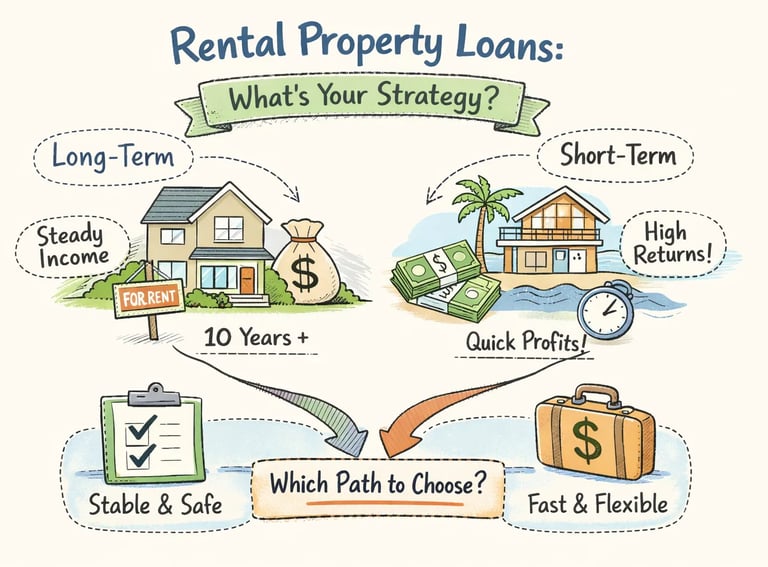
Most investors understand they need financing to buy a rental property. What trips them up is discovering that "rental property loan" isn't one product; it's a category with four or five fundamentally different options, each built for a different investor profile. Pick the wrong one and you could miss a deal because the approval takes too long, kill your cash flow with terms that don't fit a buy-and-hold strategy, or lock yourself out entirely because your income documentation doesn't match what the lender needs.
The options available to investors have changed significantly. A new class of lenders, including private investment lenders like Cape Henry Capital, now qualifies borrowers based on what the property earns rather than what shows up on a W-2. That shift opened the door for self-employed investors, portfolio builders, and anyone whose tax returns don't reflect their actual financial position. But it also means the decision of which rental property loan to use requires more thought than it used to.
This article walks you through each main loan type, what it costs, who qualifies, and which investment strategy it actually serves. By the end, you'll know exactly where to start based on your situation.
The main types of rental property loans in 2026
There are four primary loan categories for investment properties: conventional, FHA, DSCR, and portfolio loans. These aren't variations of the same mortgage; they're distinct products designed for different borrower profiles and investment goals. Understanding the differences upfront saves you from applying for the wrong product and wasting weeks in underwriting.
Conventional loans follow Fannie Mae and Freddie Mac guidelines and are the most widely available. FHA loans provide low-down-payment access for investors willing to live in one unit of a 2, 4 unit property. DSCR loans qualify based on rental income rather than personal income. Portfolio loans are held by the lender and offer more flexibility for complex or high-volume investors. Each one has a clear use case, and the right choice depends entirely on your financial profile and strategy.
Conventional loans: the baseline option
Conventional loans require a minimum 620 credit score to qualify, though you'll need 720 or higher to access the best pricing. Down payments run 20, 25% for investment properties, and lenders want your debt-to-income ratio under 45%, with many preferring 36% or lower. Fannie Mae and Freddie Mac agency guidelines allow multiple financed properties per borrower, though individual lenders commonly apply overlays that cap their own exposure, often at four financed properties, so confirm the specific limits with each lender before assuming full agency flexibility applies.
The rate is lower than most alternatives when your profile is strong, and the underwriting process is well-understood. The catch is income documentation: you'll need two years of tax returns, W-2s, pay stubs, and full DTI verification. This loan works best for a salaried investor with a clean credit profile, stable employment, and limited existing debt. If that's your situation, conventional financing is the strongest starting point.
FHA loans and the house-hacking path
FHA loans apply to 2, 4 unit properties when the investor lives in one unit for at least 12 months. The 3.5% down payment and 620 credit score minimum make this one of the lowest-barrier entry points into investment real estate. You get the benefit of collecting rent from the other units while your mortgage payment is partially covered by that income.
Treat FHA as a starter strategy, not a scalable one. FHA programs carry owner-occupancy requirements and restrictions on holding multiple FHA loans simultaneously, check current FHA guidelines for the specific rules that apply to your situation. The mortgage insurance premium also adds to your carrying cost. Once you've built equity and move on to your next property, conventional or DSCR financing takes over.
DSCR loans: qualifying on property income, not yours
DSCR loans flip the underwriting model entirely. Instead of reviewing your W-2s, tax returns, and personal debt load, the lender evaluates one thing: does the property's rental income cover the mortgage payment? For investors who are self-employed, carry significant real estate write-offs, or are building a portfolio beyond what their personal tax returns support, this rental property loan changes what's possible. For a practical primer on qualifying strategies, see what DSCR loan requirements are currently.
The approval is driven by a single ratio, the Debt Service Coverage Ratio. Unlike a conventional investment property loan, your personal income, employment history, and DTI are not part of the equation. Whether the property qualifies comes down entirely to what the market will pay in rent, which is why DSCR lending has become one of the most practical landlord loan structures available to active investors. Lenders that specialize in DSCR products also explain how these loans can be used to finance multiple investment properties with a DSCR loan.
How the DSCR ratio is calculated
The formula is straightforward: Net Operating Income divided by total debt service. If a property rents for $2,000 per month and the mortgage payment is $1,500, the DSCR is 1.33. Most lenders require a minimum ratio of 1.25, meaning rental income must exceed the mortgage by at least 25%. Some lenders will go as low as 1.0, though that comes with higher rates and stricter conditions.
Lenders establish the income figure using existing lease agreements or automated rental valuations, no personal tax returns required. A short-term rental property can use AirDNA market data in place of a lease. The documentation package is lean by design, which is why DSCR approvals move faster than conventional ones. Some lenders even pair DSCR underwriting with investor-specific products like an investor cash flow mortgage program to streamline approval for experienced operators.
Who benefits most from a DSCR loan
DSCR financing serves a distinct set of investor profiles. Self-employed borrowers whose legitimate tax write-offs reduce reported income on paper find conventional DTI calculations unworkable, DSCR sidesteps that entirely. Investors who already hold multiple financed properties and have hit their conventional loan ceiling use DSCR to keep scaling without income documentation barriers. BRRRR-strategy investors also rely on DSCR as a clean refinance path after rehabbing and stabilizing a property.
Cape Henry Capital underwrites DSCR loans based entirely on what the property earns, not what your personal return shows. Minimum credit score is 650, down payment is typically 20, 25%, and loan amounts scale up to several million dollars for the right deal. If the property cash flows, the qualification conversation is straightforward. For current market pricing on DSCR products, lenders publish updates such as this DSCR loan rates page that illustrates common pricing bands.
Portfolio loans: flexible rental property financing for serious investors
Portfolio loans are held by the lender on their own books rather than sold into the secondary market. That distinction matters because it removes the Fannie Mae and Freddie Mac guideline requirements entirely. The lender sets its own rules, which creates room for customized terms, flexible documentation, and financing scenarios that conforming products simply can't accommodate. For single-family rental operators analyzing their portfolio or the purchase of an additional portfolio, check out this DSCR portfolio loan calculator.
These loans are particularly useful for investors with complex income profiles, mixed property types across their portfolio, or a need to wrap multiple properties into a single loan structure, sometimes called a blanket loan. Because the lender evaluates each property's cash flow independently, portfolio underwriting aligns naturally with DSCR-style analysis.
How portfolio loans differ from conforming products
Without secondary market guidelines to follow, the lender decides what it will and won't finance. That can mean more flexibility on documentation standards, property condition, or borrower profile. It can also mean higher rates and fees compared to conventional loans, since the lender is taking on the full risk of the loan with no government backstop. The terms you get depend entirely on the lender's risk appetite and the strength of your deal.
When a portfolio loan is the right call
Portfolio loans suit investors in a few specific situations: someone approaching agency limits on financed properties, a borrower with a portfolio spanning mixed property types that don't fit clean conforming guidelines, or an investor who wants to consolidate multiple properties under one loan. The flexibility is real, but so is the variability in pricing. Credit score minimums vary by lender, so confirm requirements directly rather than assuming a universal floor applies.
What lenders actually look at when you apply
Investors often assume requirements for rental property loans all follow the same template. They don't. A DSCR lender and a conventional bank are looking at entirely different inputs when they evaluate your application, and confusing the two wastes time. Here's how the key variables break down across each loan type. For a high-level overview of the various rental property loan choices, see this rental property loans article.
Rental property loan qualification: credit scores, down payments, and DTI
Conventional loans require a 620 minimum credit score, with 720 or higher unlocking the best pricing. Down payment is 20, 25%, and DTI must stay under 45%. FHA loans require 620 and accept 3.5% down, but demand owner-occupancy. DSCR loans set the floor at 650 with 20, 25% down and replace DTI review with property cash flow analysis. Portfolio loans are lender-specific, credit requirements and terms vary, so treat any published floor as a starting point for negotiation, not a firm industry standard. Also confirm current conforming loan limits via the FHFA's conforming loan limit data and the FHFA's announcement of conforming loan limit values for 2026.
One rule applies across all loan types: a higher down payment consistently improves rate pricing. Moving from 20% down to 25% down can shift your rate enough to change the cash flow math on a long-term hold, the exact impact varies by lender and market, but the direction is consistent. Run that scenario before deciding how much capital to deploy at closing. For context on how current market rates affect investment math, see this investment property interest rates guide.
Cash reserves and documentation requirements
Most conventional lenders require six months of PITI reserves per financed property. For an investor holding five financed properties, that reserve requirement can reach $40,000 or more in liquid assets before closing, depending on the assumed monthly payment across each property. DSCR loans also require reserves, but the documentation is lighter: leases and property income statements replace pay stubs and tax returns entirely. Lenders and brokers outline typical reserve rules in resources like the financial reserves requirement and consumer-facing explainers on cash reserves for mortgage.
If you're self-employed or your reported income is heavily reduced by write-offs, DSCR qualification is a cleaner path than conventional. Trying to reverse-engineer two years of tax returns to hit a lender's DTI threshold is rarely worth the effort when the property's cash flow tells the real story on its own.
What rental property loan rates actually look like in 2026
Investment property loans carry a rate premium over primary residence mortgages because lenders treat them as higher risk. Historical default data shows that borrowers under financial pressure are more likely to default on an investment property before their primary home. That default risk is priced into every investment property loan, regardless of how strong the borrower looks on paper.
As of early 2026, mortgage rates remain elevated compared to the ultra-low-rate environment of prior years, though they have stabilized relative to peak volatility in 2023–2024. Freddie Mac’s benchmark for 30-year fixed primary residence mortgages is generally trending in the mid-to-high 6% range, depending on market conditions.
Investment property loans continue to carry a pricing premium due to higher perceived risk. Conventional investment property rates typically run 0.50% to 1.25% higher than primary residence loans, putting most investor borrowers in the 7.0% to 8.5% range, depending on credit score, leverage, and reserves.
DSCR loans from private lenders generally price higher than conventional loans due to their flexible underwriting structure. In 2026, most DSCR loan rates fall in the mid-6% to 9%+ range, depending on:
Loan-to-value (LTV)
Credit score
Property type (long-term vs short-term rental)
Borrowers with stronger profiles (e.g., 740+ credit, 25% down, DSCR ≥1.30) can access the lower end of that range, while higher-leverage or lower-DSCR scenarios price toward the upper end.
Adjustable-rate mortgages (ARMs) and interest-only options remain common in DSCR lending and can reduce initial monthly payments for investors with shorter hold timelines.
Factors that move your rate up or down
Lenders price investment property loans based on five variables: credit score, LTV, loan term, property type, experience and DSCR analysis. A borrower at 25% down with a 740 credit score and a DSCR of 1.35 prices very differently from someone at 20% down with a 660 score and a 1.10 ratio. The spread between best and worst pricing in the same market can exceed a full percentage point.
That gap is a reason to shop and compare rather than accept the first quote you receive. Request loan evaluations from two or three lenders with specific property details, compare the all-in payment structure, and factor rate against closing costs before choosing. A slightly higher rate with lower fees can produce better economics than the reverse on a 5-year hold.
Matching the right rental property loan to your investment strategy
For a salaried investor with stable W-2 income, clean credit, and a straightforward financial profile, conventional financing is the strongest starting point. The cost of capital is lower, the process is well-understood, and the approval criteria are predictable. For someone willing to live in the property, FHA on a 2, 4 unit delivers the lowest barrier to entry in the market. Both paths have ceilings: conventional becomes restrictive as your portfolio grows and your income documentation gets more complex, and FHA requires personal occupancy. If you want an overview of which loan type best fits specific rental strategies, see this what type of loan is best for rental property resource.
For investors who are self-employed, have already built a meaningful portfolio, or simply don't want to run personal income through a lender's underwriting process, DSCR is the natural next step. The qualification is cleaner, the documentation is lighter, and the product scales without the income verification friction that blocks conventional growth. Think of it as the buy-to-let mortgage structure evolved for the U.S. market, property performance drives the decision, not personal income. For single-family rental specifics and emerging market trends, check out these guides for Florida, Texas, Maryland and Virginia rental markets.
Buy-and-hold and first-time investors
First-time investors with salaried income should start with conventional financing. The rates are competitive, the process is familiar, and you'll build equity on terms designed for long holds. If you're buying a 2, 4 unit property and willing to occupy one unit, FHA gives you access to 3.5% down and a lower credit threshold. Use that entry point strategically, build equity, then move to conventional or DSCR for your next acquisition. For additional lender and product options aimed at buy-and-hold investors, review market overviews such as loans for real estate investors and curated lists of the best loans for investment property.
Scaling investors and the path to prequalification
Once you're scaling beyond two or three properties, or once your personal income situation doesn't map cleanly to a conventional underwriting checklist, DSCR becomes the more practical tool. It removes the income verification bottleneck and lets the deal stand on its own merits. You don't need a perfect tax return, you need a property that cash flows above the lender's DSCR threshold. Lenders and brokers also publish comparative analyses showing how DSCR pricing and operational requirements differ from agency loans; see an example investment property interest rates guide for context.
Cape Henry Capital offers instant prequalification letters in under 10 minutes, with full loan evaluations delivered within 24 hours. There are no middlemen and no weeks-long back-and-forth through a loan officer who doesn't make decisions. If you know the rent the property generates, you have enough to start the prequalification conversation today.
The bottom line on rental property financing
The right rental property loan isn't the one with the lowest rate in isolation, it's the one your profile actually qualifies for and that aligns with your hold strategy. Conventional loans serve clean-income investors starting out. FHA opens the door for house hackers. DSCR loans handle the qualification for anyone building on property cash flow. Portfolio loans provide the flexibility that conforming products can't when your situation gets more complex.
Private lenders have removed a significant amount of friction from the investor lending process. The old model required months of documentation, personal income scrutiny, and lender timelines that didn't match the pace of real estate deals. That model still exists at most banks. The alternative is a lender that underwrites on what the property earns and closes on a timeline that actually works for investors, which is exactly how Cape Henry Capital approaches every rental property loan.
Run your numbers, understand which loan type fits your profile, and get prequalified before your next deal hits the market. The investors who move fast do it because their financing is already in place. Start your prequalification at Cape Henry Capital and know exactly where you stand before you bid.
Tailored loans for real estate investors.
info@capehenrycapital.com
p. 757-267-9495
© Cape Henry Capital, LLC. 2023 All Rights Reserved. NMLS # 2383447.
Capehenrycapital.com is a website operated Cape Henry Capital, LLC, a Delaware limited liability company (“Cape Henry Capital”). By accessing this site and any pages thereof, you agree to be bound by our terms of use and privacy policy. The use of this website does not constitute an application for a mortgage loan or an offer by Cape Henry Capital to lend.
Cape Henry Capital is a mortgage broker and not a lender. Cape Henry Capital is licensed in FL,GA,PA,SC,TX. Please visit www.nmlsconsumeraccess.org for more licensing information.
Mortgage loan products referenced in this website are offered to qualified borrowers for business or commercial purposes only and may be secured by non-owner-occupied properties only.
Origination fees and other fees may apply. Financing is subject to certain restrictions and requirements including, but not limited to, due diligence, credit evaluation, and approval of the subject property. To qualify, borrowers must meet underwriting requirements. Not all borrowers will qualify and not all borrowers that qualify will receive the lowest rate. The actual loan rate and terms depend on a variety of factors. Actual rates, terms, and conditions are subject to change from time to time without notice.
Cape Henry Capital’s principal business address is 500 Studio Drive, Suite 101, Virginia Beach, VA 23452


1340 N. Great Neck Road, Suite 1272, #191 Virginia Beach, VA 23454


Check Out our Newsletter for Market Trends, Updates and Investor Resources