
DSCR Loans for Short-Term Rentals
Finance your Airbnb or vacation rental without W-2 income. Cape Henry Capital uses AirDNA data to qualify investors in FL, GA, TX, PA & SC. Get a free analysis.
DSCR LOANSSHORT-TERM RENTAL PROPERTY (STR)
Jarad Francis
1/22/20266 min read
Key Sections:
Are Short-Term Rentals Still a Smart Portfolio Addition?
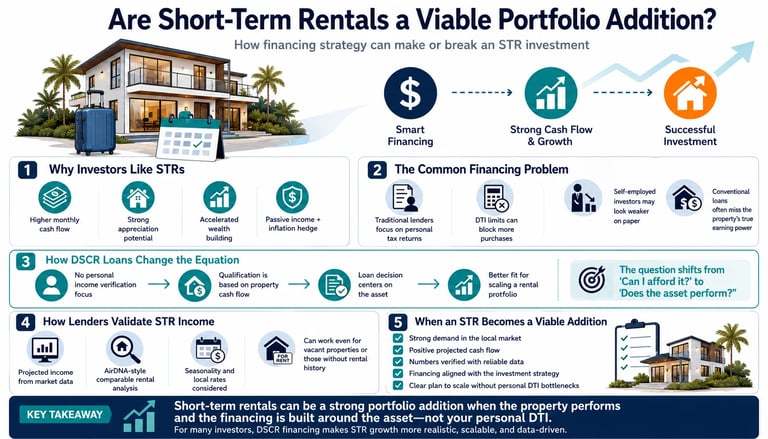
The rise of platforms like Airbnb and VRBO has fundamentally changed the real estate landscape. For many investors, the allure is clear: short-term rentals (STRs) often generate significantly higher monthly cash flow than traditional long-term leases, frequently 2x to 3x the rent of a comparable long-term property in the same market.
They offer a path to accelerated wealth building and asset appreciation that few other investment vehicles can match. But for many investors, the roadblock isn't the property, it's the financing.
Questioning the viability of adding an STR to your portfolio is a necessary step in due diligence. If you've been hitting walls with traditional lenders, this guide is for you. We'll break down exactly how DSCR loans work for short-term rentals, what you need to qualify, and why more real estate investors are using them to scale their portfolios in 2025 and beyond.
What Is a DSCR Loan?
A DSCR loan (Debt Service Coverage Ratio loan) is a type of investment property mortgage that qualifies you based on the income the property generates, not your personal W-2, tax returns, or employment history.
The DSCR formula is simple:
DSCR = Net Operating Income ÷ Annual Debt Service
A DSCR of 1.0 means the property's income exactly covers the mortgage payment.
A DSCR of 1.25 means the property earns 25% more than the mortgage, a comfortable cushion most lenders prefer.
A DSCR below 1.0 means the property doesn't fully cover the debt, some lenders will still approve with strong compensating factors.
Example: If a short-term rental generates $48,000/year in net operating income and the annual mortgage payment is $40,000, the DSCR is 1.20, qualifying territory for most lenders.
This structure is what makes DSCR loans so powerful for STR investors. Instead of being limited by your DTI (debt-to-income ratio), you're evaluated on whether the asset performs.
If you still have questions about how dscr loans work, our guide DSCR Loans Explained is a must read.
The Disconnect Between Potential and Financing
A common frustration among investors, from high-earning entrepreneurs to seasoned real estate pros, is the friction with traditional banking.
You identify a vacation property in a high-demand resort town with excellent revenue potential. The numbers make sense. The projected cash flow is there. But when you approach a traditional lender, they focus entirely on your personal tax returns rather than the property's potential.
If you're self-employed, an entrepreneur, or a commissioned professional, your taxable income likely doesn't reflect your actual buying power. Aggressive tax strategies, depreciation, write-offs, pass-through deductions, are smart financially, but they make you look like a risk to a conventional underwriter.
The result: qualified investors get rejected for loans on cash-flowing properties. That's a broken system, and DSCR loans exist specifically to fix it.
Changing the equation with DSCR loans
The viability of your STR investment often improves the moment you shift your financing strategy. DSCR (Debt Service Coverage Ratio) loans have become the go-to solution for investors who want to bypass the DTI headaches.
Unlike a traditional mortgage, a DSCR loan does not scrutinize your personal income or employment history. Instead, the lender looks at the property’s ability to pay for itself. They calculate the DSCR ratio by dividing the property's annual net operating income by its annual debt service. If the rent covers the mortgage, you generally qualify.
This shifts the conversation from "Can I afford this?" to "Does the asset perform?". For investors looking to scale, this is a game-changer. It means you can add a short-term rental to your portfolio based on its own merit, not on your personal DTI ratio.
DSCR Loan Requirements for Short-Term Rentals
While every lender sets their own guidelines, here's what most investors can expect when applying for a DSCR loan on a short-term rental:
One important note: short-term rental zoning and local regulations matter. Some lenders will not finance STRs in markets with strict licensing requirements or active STR bans. Doing your regulatory due diligence before applying saves time for everyone.
How Lenders Validate Short-Term Rental Income
One of the biggest objections to STR investing is the perceived instability of income. Is Airbnb revenue reliable enough to base a loan on? What if occupancy drops?
Sophisticated lenders don't rely on guesswork, and they don't require an existing rental history either. They use market data from trusted third-party sources like AirDNA to project rental income.
Here's how it works:
AirDNA aggregates performance data from millions of Airbnb and VRBO listings across every major market. When a lender uses AirDNA to underwrite your loan, they're looking at:
Average Daily Rate (ADR), what comparable properties in your zip code charge per night
Occupancy Rate, the percentage of nights booked by similar properties in the same area
Revenue Per Available Room (RevPAR), the blended metric that combines both
Seasonality adjustments, accounting for peak and off-peak periods in your target market
This data-driven approach means your loan qualification is grounded in real market comps, not assumptions. It also means you can finance a vacant property or a new listing with no prior rental history, as long as the market data supports the income projection.
For investors, this is a game-changer. You're not penalized for being early into a market. You're evaluated on what the market actually produces.
Scaling Your Portfolio Without the Red Tape
For investors looking to move beyond a single property, viability is about scalability. Traditional loans often cap the number of mortgages you can hold (Fannie Mae caps at 10), and each subsequent application requires increasingly invasive documentation.
DSCR loans operate outside of conventional agency guidelines. Because each loan is evaluated on the asset's performance rather than your personal balance sheet, there's no hard cap on how many DSCR loans you can hold. As long as each property cash flows, your personal financial complexity doesn't become a bottleneck.
This makes DSCR loans the preferred path for investors building portfolios of 5, 10, or even 20+ short-term rentals. Each property stands on its own. Each deal is evaluated on its own merits.
Short-Term Rental DSCR Loans by State
Cape Henry Capital offers DSCR loans for short-term rentals across multiple markets. Here's a quick snapshot of what investors should know in each state we serve:
Florida
Florida remains one of the most active STR markets in the country, with strong year-round demand in coastal markets (Miami, Tampa, Destin, St. Augustine) and theme park corridors (Orlando/Kissimmee). STR regulations vary significantly by county and municipality, some areas like Miami Beach have strict limits, while others are investor-friendly. AirDNA data for Florida markets is highly developed, making income projections reliable.
Learn more about DSCR loans for rental property in Florida →
Georgia
Georgia's STR market is anchored by Atlanta (strong corporate and event-driven demand) and mountain markets like Blue Ridge and Helen, which attract consistent leisure travelers. Georgia does not have statewide STR regulations, so local ordinances vary. Blue Ridge in particular is a perennial high-performer for STR investors.
Texas
Texas is one of the largest and most diverse STR markets in the U.S., from Austin and San Antonio to the Hill Country, Gulf Coast, and Big Bend. Texas has no state income tax, investor-friendly property laws, and a robust short-term rental market. DSCR underwriting in Texas benefits from deep AirDNA datasets across every major metro.
Learn more about Texas DSCR rental property loans →
Pennsylvania
Pennsylvania's STR market is concentrated in the Poconos, a four-season destination with strong weekend demand from the NYC/Philadelphia/NJ drive market. The Poconos consistently rank among the top STR markets in the Northeast for RevPAR. Philadelphia also has an active STR market for urban investors.
South Carolina
South Carolina's coastal markets, Myrtle Beach, Hilton Head, Isle of Palms, Kiawah Island, are among the most established vacation rental destinations in the Southeast. These markets have well-documented rental histories, making DSCR qualification straightforward.
Is a Short-Term Rental Right for Your Portfolio?
Short-term rentals aren't the right fit for every investor. Before you apply for financing, ask yourself:
Do you have a market identified? STR performance varies dramatically by location. A property 20 miles outside a destination market can underperform significantly versus one inside it.
Have you run the numbers with real data? Use AirDNA, Rabbu, or Mashvisor to validate projected income before you fall in love with a property.
Do you understand the operational requirements? STRs require active management, cleaning, guest communications, pricing optimization, or a property manager (typically 20-30% of revenue).
Are you clear on local regulations? Some municipalities require STR licenses, limit the number of rental days, or restrict rentals in certain zones entirely.
If you've done this work and the property pencils out, DSCR financing removes the last major barrier for most investors.
See If Your Airbnb Qualifies
Short-term rentals remain one of the most powerful tools for generating passive income and building long-term wealth. If traditional financing has been the roadblock, a DSCR loan removes it.
Cape Henry Capital specializes in DSCR loans for real estate investors in Florida, Georgia, Texas, Pennsylvania, and South Carolina. We use AirDNA data to underwrite income projections, and we don't require W-2s, tax returns, or employment verification.
Don't let financing uncertainty stall your investment goals. Get a clear picture of your property's potential with a free analysis, before you apply.
Get a Free Analysis → | Use Our DSCR Loan Calculator →
Tailored loans for real estate investors.
info@capehenrycapital.com
p. 757-267-9495
© Cape Henry Capital, LLC. 2023 All Rights Reserved. NMLS # 2383447.
Capehenrycapital.com is a website operated Cape Henry Capital, LLC, a Delaware limited liability company (“Cape Henry Capital”). By accessing this site and any pages thereof, you agree to be bound by our terms of use and privacy policy. The use of this website does not constitute an application for a mortgage loan or an offer by Cape Henry Capital to lend.
Cape Henry Capital is a mortgage broker and not a lender. Cape Henry Capital is licensed in FL,GA,PA,SC,TX. Please visit www.nmlsconsumeraccess.org for more licensing information.
Mortgage loan products referenced in this website are offered to qualified borrowers for business or commercial purposes only and may be secured by non-owner-occupied properties only.
Origination fees and other fees may apply. Financing is subject to certain restrictions and requirements including, but not limited to, due diligence, credit evaluation, and approval of the subject property. To qualify, borrowers must meet underwriting requirements. Not all borrowers will qualify and not all borrowers that qualify will receive the lowest rate. The actual loan rate and terms depend on a variety of factors. Actual rates, terms, and conditions are subject to change from time to time without notice.
Cape Henry Capital’s principal business address is 500 Studio Drive, Suite 101, Virginia Beach, VA 23452


1340 N. Great Neck Road, Suite 1272, #191 Virginia Beach, VA 23454


Check Out our Newsletter for Market Trends, Updates and Investor Resources